
0%
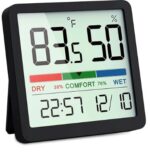

Digital Temperature Humidity Meter
$0.00
Digital Temperature Humidity Meter
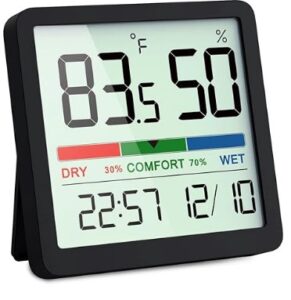
Digital Temperature Humidity Meter
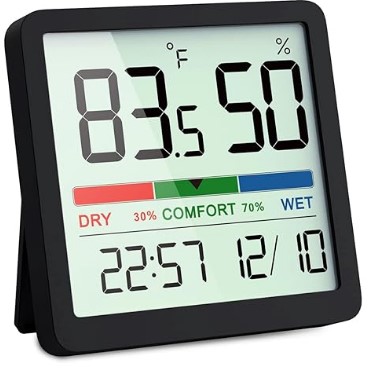
A Digital Temperature Humidity Meter, also known as a digital hygrometer, is an electronic device used to measure and display the relative humidity (RH) of the air, often along with temperature. It’s commonly used in laboratories, industrial settings, storage areas, and homes to monitor moisture levels.
Key Features of Digital Temperature Humidity Meter:
– Digital Display: Shows humidity (in % RH) and often temperature (in °C/°F).
– Sensor-Based Measurement: Uses capacitive or resistive sensors for accurate readings.
– Compact & Portable: Available in handheld or wall-mountable forms.
– Data Logging (in some models): Records humidity levels over time for analysis.
– Min/Max Readings: Displays historical high and low humidity values.
Common Applications of Digital Temperature Humidity Meter:
– Laboratories: Maintaining stable humidity for experiments or sample storage.
– Warehouses: Monitoring conditions for sensitive goods (e.g., electronics, paper, pharmaceuticals).
– HVAC Systems: Ensuring proper climate control.
– Homes: Preventing mold growth or overly dry conditions.
Benefits of Digital Temperature Humidity Meter:
– Accurate and quick readings
– Easy to use and read
– Helps in maintaining comfort, safety, and product integrity
Would you like recommendations for models or guidance on calibration?
Benefits of Digital Humidity meter
Here are the key benefits of using a Digital Humidity Meter:
✅ 1. Accurate Humidity Monitoring
– Provides precise relative humidity (%RH) readings, essential for sensitive environments.
✅ 2. Fast and Real-Time Results
– Displays immediate data, allowing for quick adjustments to environmental conditions.
✅ 3. Dual Measurement
– Many models also measure temperature, offering a more complete picture of ambient conditions.
✅ 4. Easy to Use
– Simple digital interface with clear display, suitable for both professionals and non-technical users.
✅ 5. Compact and Portable
– Lightweight design makes it ideal for field use, indoor monitoring, or mounting on walls.
✅ 6. Prevents Damage
– Helps avoid moisture-related issues like mold, corrosion, static buildup, and product degradation.
✅ 7. Supports Quality Control
– Essential for labs, warehouses, and manufacturing environments to maintain product integrity.
✅ 8. Data Logging (Optional)
How to use Digital Humidity meter
Here are the key features of a Digital Humidity Meter:
1. Digital Display
– Shows real-time humidity (%) and often temperature (°C/°F).
– Some include backlit screens for easy viewing.
2. High Accuracy Sensors
– Uses capacitive or resistive sensors for accurate and stable humidity readings.
3. Min/Max & Hold Functions
– Displays minimum, maximum, and current readings.
– “Hold” function freezes the current reading for review.
4. Data Logging (in advanced models)
– Records humidity data over time for monitoring trends.
5. Portable or Wall-Mountable
– Available as handheld, desktop, or wall-mounted units for different environments.
6. Battery or USB Powered
– Operates on standard batteries or via USB power for flexibility.
7. Optional External Probes
– Some models support external humidity/temperature sensors for remote monitoring.
8. Calibration Option
– Allows manual or automatic calibration to maintain accuracy.
Here’s a quick step-by-step guide on how to use a Digital Temperature Humidity Meter:
✅ 1. Power On the Device
– Insert batteries (if portable) or plug it in (if wall-mounted).
– Press the power button to turn it on.
✅ 2. Place It Properly
– Set the meter in an open, well-ventilated area.
– Avoid placing near windows, vents, or direct heat sources for accurate readings.
✅ 3. Wait for Stabilization
– Allow the device a few seconds to stabilize and show accurate humidity and temperature readings.
✅ 4. Read the Display
– Humidity will be shown as % RH (Relative Humidity).
– Most models also display temperature in °C or °F.
✅ 5. Use Additional Features (if available)
– Press buttons to view Min/Max, Data Log, or switch units.
– Some advanced models may have Bluetooth or USB for data transfer.
✅ 6. Maintain the Device
– Clean sensor area gently if dusty.
– Calibrate periodically if required (check manual).
Description
Shipping & Delivery
Related products
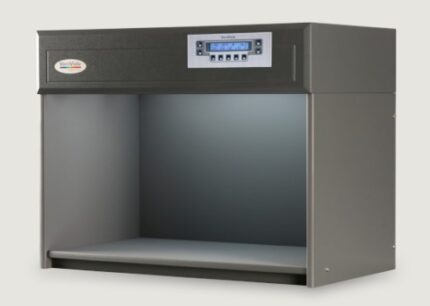

VeriVide Colour Assessment Cabinets
VeriVide Colour Assessment Cabinets
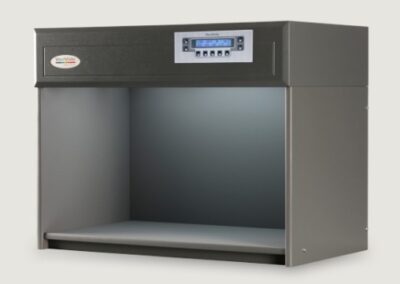 VeriVide offers high-quality Colour Assessment Cabinets (CACs) such as the CAC 60-4, CAC 60-5, and CAC 120-4&5. These cabinets, originating from the UK, are reliable tools for visual evaluation in quality assurance, meeting national, international, and retailer standards. They effectively mitigate issues related to color assessment.VeriVide Colour Assessment Cabinets
High-quality visual evaluation tool for quality assurance. Adhering to national, international and retailer standards.Colour Assessment Cabinet's (CACs) reduce problems associated with assessing products or samples in different environments,be though geological or seasonal, offering a cost-effective method to ensure visual accuracy and product quality.
Color Light Box Enhance color precision with VeriVide's cutting-edge Colour Assessment
Cabinets. These cabinets are meticulously designed to ensure accurate color evaluation in various industries. Invest in VeriVide Colour Assessment Cabinets to elevate your color assessment process.
Enhance Color Precision with VeriVide's Cutting-Edge Assessment Cabinets, which meet or surpass ISO 3664 and BS 950 Part 1 international standards. The cabinets are adaptable to user requirements, with lamp options to choose different light sources. Available in 60, 120, and 150cm widths, VeriVide Colour Assessment Cabinets provide a flexible solution for accurate color assessment.
Incorporate user-friendly features like servicing indicator, auto sequence, warm-up, power save and data storage.4 or 5 light source options Versions available for colour fastness testing and particulate testing both adhering to global standardsEnsure that you are using the best equipment available as they provide the best fluorescent D65 daylight simulator, with the highest Colour
Rendering Index (CRI), available. VeriVide Colour Assessment Cabinets products are known as light boxes, viewing booths, colour cabinets and others, depending on which industry or country they are serving in. They are used within a wide array of industry sectors throughout the world including textile and apparel, graphics, automotive, ceramics, cosmetics, pharmacology (CAC Particulate),
food, footwear, packaging and printing.Download the Datasheet below for more information or click 'VeriVide CAC Datasheet Here' to get in touch with colour experts.
VeriVide CAC Datasheet Here Features of VeriVide Colour Assessment Cabinets
• CAC 60, CAC 120 and CAC 150 accommodate 60, 120 and 150cm tubes respectively
VeriVide offers high-quality Colour Assessment Cabinets (CACs) such as the CAC 60-4, CAC 60-5, and CAC 120-4&5. These cabinets, originating from the UK, are reliable tools for visual evaluation in quality assurance, meeting national, international, and retailer standards. They effectively mitigate issues related to color assessment.VeriVide Colour Assessment Cabinets
High-quality visual evaluation tool for quality assurance. Adhering to national, international and retailer standards.Colour Assessment Cabinet's (CACs) reduce problems associated with assessing products or samples in different environments,be though geological or seasonal, offering a cost-effective method to ensure visual accuracy and product quality.
Color Light Box Enhance color precision with VeriVide's cutting-edge Colour Assessment
Cabinets. These cabinets are meticulously designed to ensure accurate color evaluation in various industries. Invest in VeriVide Colour Assessment Cabinets to elevate your color assessment process.
Enhance Color Precision with VeriVide's Cutting-Edge Assessment Cabinets, which meet or surpass ISO 3664 and BS 950 Part 1 international standards. The cabinets are adaptable to user requirements, with lamp options to choose different light sources. Available in 60, 120, and 150cm widths, VeriVide Colour Assessment Cabinets provide a flexible solution for accurate color assessment.
Incorporate user-friendly features like servicing indicator, auto sequence, warm-up, power save and data storage.4 or 5 light source options Versions available for colour fastness testing and particulate testing both adhering to global standardsEnsure that you are using the best equipment available as they provide the best fluorescent D65 daylight simulator, with the highest Colour
Rendering Index (CRI), available. VeriVide Colour Assessment Cabinets products are known as light boxes, viewing booths, colour cabinets and others, depending on which industry or country they are serving in. They are used within a wide array of industry sectors throughout the world including textile and apparel, graphics, automotive, ceramics, cosmetics, pharmacology (CAC Particulate),
food, footwear, packaging and printing.Download the Datasheet below for more information or click 'VeriVide CAC Datasheet Here' to get in touch with colour experts.
VeriVide CAC Datasheet Here Features of VeriVide Colour Assessment Cabinets
• CAC 60, CAC 120 and CAC 150 accommodate 60, 120 and 150cm tubes respectively
- Either 4 or 5 light sources available for each model including D65, D50, 840P15, F and UV - see Lamp Options.• Internal finishes in Munsell N5, Munsell N7 or Grey 5574 • Diffuser and/or dimmer options available Dimensions of VeriVide Colour Assessment Cabinets CAC 60-4 Dimensions (mm) Width Height Depth Overall 710 545 420
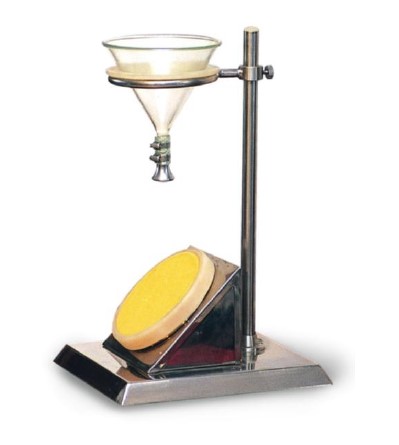
Spray Rating Tester
Spray Rating Tester

Spray Rating Tester
- Quick and Simple Evaluation - Offers a fast way to assess fabric water repellency without complex setup.
- Standardized Testing- Complies with AATCC 22 and ISO 4920, ensuring globally accepted results.
- Cost-Effective- Low maintenance and no power requirement make it economical for routine lab use.
- Improves Fabric Performance - Helps manufacturers develop or improve water-resistant textiles.
- Non-Destructive Test - Does not damage the fabric, allowing for additional tests on the same sample.
- Visual Grading- Easy to interpret using a standard spray rating chart (0 to 100 scale).
- Supports Quality Control - Detects finish degradation or variation in water-repellent treatments.
- Portable and Compact- Lightweight design allows easy use in various lab or field settings.
- Standardized Spray Nozzle - Delivers consistent water spray per AATCC and ISO specifications.
- 45° Specimen Mounting Angle - Ensures uniform test setup for accurate and repeatable results.
- Stainless Steel or Aluminum Frame - Corrosion-resistant and durable for long-term use with water exposure.
- Water Reservoir and Funnel System - Provides precise water volume (usually 250 ml) for each test.
- Graduated Spray Stand- Fixed height (150 mm above specimen) for controlled spray impact.
- Detachable Specimen Holder- Easy loading and removal of fabric samples.
- Compact and Lightweight Design - Portable and convenient for both lab and field testing.
- No Electricity Required - Fully manual operation increases reliability and reduces operating costs.
- Prepare the Sample - Cut fabric to standard size (usually 180 × 180 mm). - Condition the sample if required (21°C, 65% RH for 24 hours).
- Mount the Fabric - Place the fabric on the specimen holder at a 45° angle.
- Fill the Reservoir - Pour 250 ml of distilled water into the upper funnel.
- Start the Test - Release the water through the nozzle; it sprays over the fabric for about 25–30 seconds.
- Inspect the Fabric - After spraying, visually assess the water beading or penetration on the surface.
- Rate the Sample - Compare the fabric’s wetting pattern with the standard spray rating chart: - 100 = No sticking/wetting - 90–50 = Partial wetting - 0 = Complete wetting
- Record the Rating - Document the spray rating for quality control or reporting.
 Spray Reting Tester
[Scope of application]:
Used for the determination of moisture resistance (wetting grade) of various fabrics
which have been or have not been treated with water resistance or water repellency.
[related standards]:
GB/T4745 ISO4920 AATCC22 JISL1092 etc.
[technical parameters]:
1. Glass funnel:150 x 150 (capacity 500ml)
2. Specimen placement angle:The level is 45 degrees.
3. Distance from nozzle to sample center:150mm
4. Specimen diameter:Ф150mm
5. Size of water receiving pan:500×400×30mm
6. Matching measuring cups:500ml
7, size 500 x 400 x 500mm
8. Instrument weight:5Kg
Spray Reting Tester
[Scope of application]:
Used for the determination of moisture resistance (wetting grade) of various fabrics
which have been or have not been treated with water resistance or water repellency.
[related standards]:
GB/T4745 ISO4920 AATCC22 JISL1092 etc.
[technical parameters]:
1. Glass funnel:150 x 150 (capacity 500ml)
2. Specimen placement angle:The level is 45 degrees.
3. Distance from nozzle to sample center:150mm
4. Specimen diameter:Ф150mm
5. Size of water receiving pan:500×400×30mm
6. Matching measuring cups:500ml
7, size 500 x 400 x 500mm
8. Instrument weight:5Kg 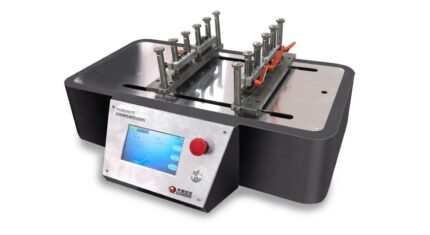
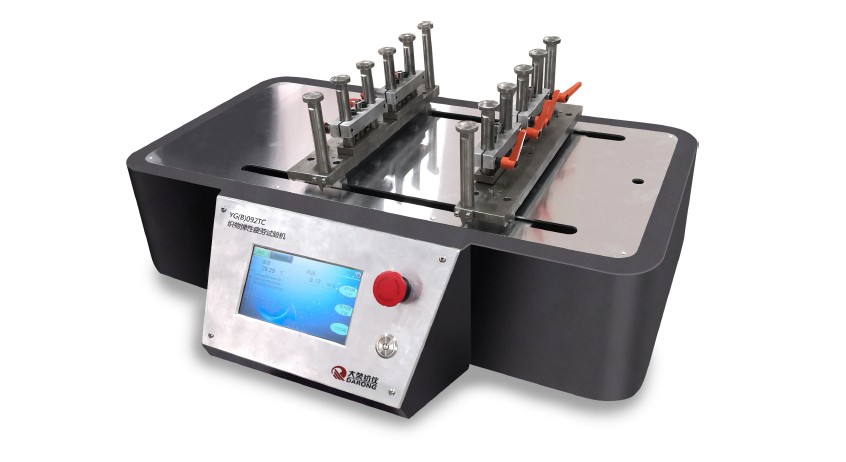
Fatigue tester for Elastic fabric
Fatigue Tester for Elastic Fabric
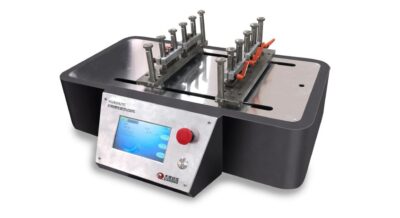
Fatigue tester for Elastic fabric
- Adjustable Stretch Range - Allows setting stretch levels (e.g., 0–100%) to simulate real-life fabric use.
- High-Cycle Capability - Supports up to millions of stretch-relax cycles for long-term fatigue analysis.
- Touch Screen Control - 7-inch color display for easy setup, monitoring, and data entry.
- Servo Motor Driven - Ensures precise and smooth linear motion during testing.
- Customizable Speed - Adjustable test speed (e.g., up to 40 cycles per minute) based on test requirements.
- Multi-Sample Testing - Some models allow testing multiple specimens simultaneously.
- Cycle Counter with Alarm - Built-in counter with programmable stop after preset cycles and auto-alert feature.
- Durable Construction - Robust metal frame suitable for continuous testing in lab environments.
- Standard Compliance - Designed to follow standards like GB/T 37635 for elastic fabric testing.
- Prepare the Sample
- Mount the Sample - Secure both ends of the fabric in the upper and lower clamps.
- Set Test Parameters
- Start the Test - Press start on the touch screen interface. - The machine will cyclically stretch and release the sample.
- Monitor Progress - Observe operation or let it run automatically.
- Remove and inspect - Take out the fabric and measure elongation, recovery, or visual defects.
- Record and Compare Results - Compare with initial measurements or standard performance criteria.
Fatigue tester for Elastic fabric

Fabric air permeability tester
Fabric Air Permeability Tester

Fabric air permeability tester
- Accurate Breathability Measurement - Precisely measures how breathable a fabric is, essential for comfort and performance.
- Supports Quality Control - Ensures consistent air permeability in fabric batches, critical for products like PPE, sportswear, and filters.
- Enhances Product Design - Helps in selecting or engineering fabrics with the right airflow properties for specific uses.
- Standard Compliance - Conforms to international testing standards (e.g., ASTM D737, ISO 9237), ensuring global credibility.
- Quick and Reliable Testing - Provides rapid results, increasing lab efficiency and production decision-making speed.
- Wide Material Compatibility - Suitable for woven, nonwoven, knitted fabrics, and even paper or coated materials.
- Improves Functional Performance - Helps optimize products for ventilation, moisture control, and thermal comfort.
- Reduces Product Failure - Identifies underperforming fabrics early, minimizing risks in high-performance applications.
- Digital Display - Shows air permeability readings clearly in units like L/m²/s or cm³/cm²/s.
- Precise Test Head/Clamp - Provides an airtight seal to prevent air leakage and ensure accurate results.
- Adjustable Pressure Settings - Allows testing under various pressure drops (e.g., 10–2500 Pa), depending on fabric type.
- Automatic Airflow Measurement - Built-in sensors or flow meters capture airflow rate automatically for quick analysis.
- Multiple Test Area Sizes - Interchangeable test plates to match different sample sizes and standard requirements.
- Data Logging and Export - Some models include USB or software connectivity for storing and exporting test results.
- Standard Compliance - Conforms to ASTM D737, ISO 9237, BS 5636, DIN 53887, etc.
- Robust Construction - Built with corrosion-resistant materials and durable components for long-term lab use.
- Low Maintenance - Simple cleaning and calibration process for reliable performance.
- Compact and User-Friendly Design - Ideal for lab benches and easy operation with minimal training.
- Prepare the Sample - Cut the fabric sample to the required size (usually circular, e.g., 20 cm²).
- Mount the Sample - Place the fabric securely in the test clamp or holder, ensuring no wrinkles or gaps.
- Set Test Parameters - Adjust the air pressure drop according to the fabric type or standard (e.g., 100 Pa).
- Start the Test - Turn on the air supply and start the airflow through the fabric.
- Read the Measurement - The digital display will show the air permeability value in the selected units.
- Record the Results - Note the readings or export data if the device supports it.
- Repeat if needed - Test multiple samples or areas for accuracy and average the results.
- Clean and Maintain - After testing, clean the clamp and ensure the device is calibrated regularly.
 r Permeability Tester
Appliance Range
It is used to TEST the air permeability of various textile fabrics, including industrial fabrics, nonwoven fabrics and other textile products and other breathable materials.
Related Standards
GB / T 5453, GB / T 13764, ISO 9237, ISO 5636, ASTM D737, etc.
Instrument characteristics
1. Automatic sample clamping, automatic nozzle replacement, and quick test.
2. Microcomputer processing, the test results are displayed directly, without manual table calculation;
3. Built-in continuous test mode, the test unit can be switched as needed.
4. Chinese LCD menu operation, configure computer interface.
Technical parameter
1. Range of sample pressure difference: 1 ~ 4000Pa
2. Measurable air permeability: 1 ~ 40,000mm / s
3. Measurement error: ≤ ± 2%
4. Measurable fabric thickness: ≤8mm
5. Test area: 5cm2; 20cm2; 50cm2; 100cm2
Ф50mm (≈19.6cm2)
Ф70mm (≈38.5cm2)
6. Nozzles: 11 in total (automatic replacement of digital setting)
CODE 00 01 02 03 04 05 06 07 08 09 10
DIAφ(mm)
0.8 1.2 2 3 4 6 8 10 12 16 20
7.Data Capacity:≤200 times tests
8.Power Supply:AC220V 50Hz 2KW
9.Weight:80Kg
10.Shape:1250×700×1250mm
r Permeability Tester
Appliance Range
It is used to TEST the air permeability of various textile fabrics, including industrial fabrics, nonwoven fabrics and other textile products and other breathable materials.
Related Standards
GB / T 5453, GB / T 13764, ISO 9237, ISO 5636, ASTM D737, etc.
Instrument characteristics
1. Automatic sample clamping, automatic nozzle replacement, and quick test.
2. Microcomputer processing, the test results are displayed directly, without manual table calculation;
3. Built-in continuous test mode, the test unit can be switched as needed.
4. Chinese LCD menu operation, configure computer interface.
Technical parameter
1. Range of sample pressure difference: 1 ~ 4000Pa
2. Measurable air permeability: 1 ~ 40,000mm / s
3. Measurement error: ≤ ± 2%
4. Measurable fabric thickness: ≤8mm
5. Test area: 5cm2; 20cm2; 50cm2; 100cm2
Ф50mm (≈19.6cm2)
Ф70mm (≈38.5cm2)
6. Nozzles: 11 in total (automatic replacement of digital setting)
CODE 00 01 02 03 04 05 06 07 08 09 10
DIAφ(mm)
0.8 1.2 2 3 4 6 8 10 12 16 20
7.Data Capacity:≤200 times tests
8.Power Supply:AC220V 50Hz 2KW
9.Weight:80Kg
10.Shape:1250×700×1250mm 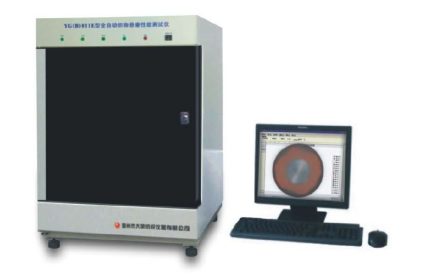
Fabric drape tester
Fabric Drape Tester
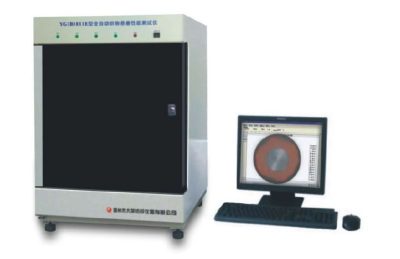
Fabric Drape Tester
- Quantifies Fabric Flow - Measures drape behavior accurately, crucial for garments and furnishings.
- Supports Design Decisions - Helps designers select fabrics that match the intended look and movement of a product.
- Improves Garment Fit and Comfort - Ensures fabrics behave naturally on the body, enhancing wear ability.
- Enhances Product Aesthetics - Prevents stiff or limp fabric choices in fashion, interior, or technical textiles.
- Standardized Evaluation - Enables comparison across fabrics using drape coefficient, based on standards (e.g., BS 5058).
- Supports R&D - Useful in developing new fabrics or finishes to improve drape quality.
- Non-Destructive Testing - Tests fabric without damaging it, allowing for further analysis.
- Boosts Quality Control - Identifies batch inconsistencies or performance issues early in production.
- Rotating Support Disc - Holds the fabric sample over a smaller disc to create natural drape.
- Standard Sample Size Support - Designed for circular fabric samples, usually 30 cm in diameter.
- Light Projection System - Projects the draped fabric’s shadow onto a screen or recording surface.
- Drape Coefficient Calculation - Measures the shadow area to compute the drape coefficient (percentage of unsupported area covered by the shadow).
- Digital or Manual Options - Available in models with digital image processing or manual plan meter tracing.
- Stable Base and Structure - Ensures consistent and vibration-free testing conditions.
- Sample Templates Provided - For cutting precise, standard-sized fabric specimens.
- User-Friendly Interface - Simple controls for rotation and light alignment.
- Compact and Lab-Ready Design - Fits easily on lab benches and in testing environments.
- Compliance with Testing Standards - Supports BS 5058 and other relevant drape measurement methods.
- Prepare the Fabric Sample - Cut a circular fabric sample, typically 30 cm in diameter, using the provided template.
- Place the Fabric - Center the fabric sample over the smaller support disc (usually 18 cm diameter) on the tester.
- Turn on the Light Source - Illuminate the fabric from above so it casts a shadow onto the recording surface or paper below.
- Capture the Shadow Outline - Trace the shadow manually on paper or capture it digitally, depending on the model.
- Measure the Shadow Area - Use a plan meter (manual) or software (digital) to determine the shadow’s area.
- Calculate Drape Coefficient (DC) - Use the formula:
- Record the Result - Log the drape coefficient to evaluate how stiff or flexible the fabric is.
- Repeat for Accuracy - Test multiple samples and average the results for consistency.
 It is used for testing dynamic and static drape properties
(drape coefficient, shape change rate, surface ripple and drape uniformity, etc.)
of various fabrics.
Related standards GB/T23329 FZ/01045 BS5058 etc.
Instrument characteristics
1. CCD imaging, dynamic and static image processing.
2. A variety of charts and data statistics, analysis, storage, output
3. No need to replace background color, can test all kinds of color samples.
4. Work mode:Microcomputer control, CCD imaging, automatic processing of images and data automatically.
Technical parameters
1. Communication interface: RS232, USB
2. Image sensor: CCD sensor.
3. Static (dynamic) state draping coefficient: 0 ~ 100% + 2
4. Drapability uniformity: 0 ~ 100% + 2
5. The rate of morphological change is 0 to 100% + 2.
6. Surface waviness error: + 1
It is used for testing dynamic and static drape properties
(drape coefficient, shape change rate, surface ripple and drape uniformity, etc.)
of various fabrics.
Related standards GB/T23329 FZ/01045 BS5058 etc.
Instrument characteristics
1. CCD imaging, dynamic and static image processing.
2. A variety of charts and data statistics, analysis, storage, output
3. No need to replace background color, can test all kinds of color samples.
4. Work mode:Microcomputer control, CCD imaging, automatic processing of images and data automatically.
Technical parameters
1. Communication interface: RS232, USB
2. Image sensor: CCD sensor.
3. Static (dynamic) state draping coefficient: 0 ~ 100% + 2
4. Drapability uniformity: 0 ~ 100% + 2
5. The rate of morphological change is 0 to 100% + 2.
6. Surface waviness error: + 1 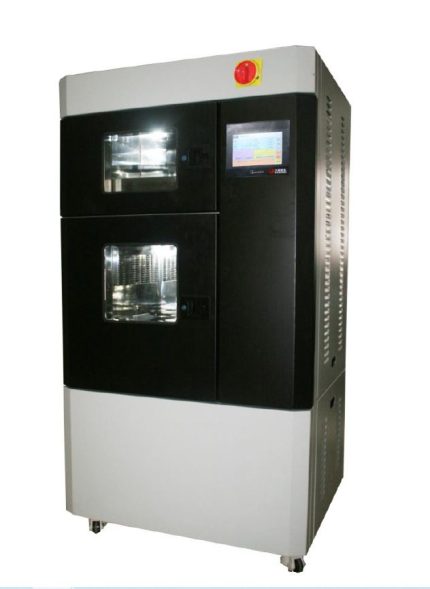
fabric moisture permeability tester
Fabric Moisture Permeability Tester
Fabric Moisture Permeability Tester
Fabric Moisture Permeability Tester
- Upright Cup Method: The fabric covers a cup containing water, and the assembly is placed upright in a controlled environment. After a set duration, the weight loss is measured to determine the WVTR.
- Inverted Cup Method: The fabric is sealed over a cup, which is then inverted and exposed to a controlled environment. The amount of water vapor absorbed by the fabric is measured over time.
- Sweating Hot Plate Test: Simulates human perspiration by measuring the energy required to maintain a constant temperature on a heated plate covered with the fabric, providing insights into the fabric's breathability.
- Multi-Cup Design - Typically includes 6 or more test cups for simultaneous testing of multiple samples.
- Rotating Turntable - Ensures uniform air exposure and consistent vapor transmission across all samples.
- Precision Weighing System- Accurate measurement of weight loss to calculate water vapor transmission rate (WVTR).
- Temperature & Humidity Control - Maintains stable environmental conditions (e.g., 23°C, 50% RH) for reliable results.
- Digital Display or Software Interface - Displays real-time data and test status; advanced models offer data logging and export.
- Compliance with Standards - Supports ASTM E96, ISO 15496, BS 7209, JIS L1099 testing methods.
- Sealed Test Chambers- Prevents external air interference, improving accuracy.
- Corrosion-Resistant Construction - Durable materials suitable for long-term use in lab environments.
- Easy Sample Mounting - Quick and secure fabric placement on test cups with sealing rings.
- Low Maintenance Design- Simplified components for easy cleaning and upkeep.
- Prepare the Test Solution - Fill each test cup with a set amount of water (e.g., 50 ml), or a desiccant if using inverted method.
- Mount the Fabric - Cut the fabric into circular pieces matching the cup size.
- Weigh the Cups - Record the initial weight of each cup with the fabric mounted.
- Place on Turntable - Position all cups on the rotating tray inside the controlled chamber.
- Set Conditions - Close the chamber and maintain temperature (e.g., 23°C) and relative humidity (e.g., 50%) as per test standard.
- Start the Test - Begin rotation (usually ~2 RPM) and let it run for the specified time (often 24 hours).
- Weigh the Cups Again- After the test duration, reweigh the cups to determine weight loss due to moisture vapor passing through the fabric. Calculate WVTR - Use the formula: WVTR = (Weight Loss in grams × 24) / (Test Area in m² × Time in hours) Expressed in g/m²/24h.Clean and Store - Clean cups and components for future use.
 Scope of application
It is used to determine the moisture permeability of various fabrics
(including moisture permeable coated fabrics)
and nonwovens such as batting cotton and space cotton.
[Related standards] GB/T12704 ASTM E90 JIS L1099A BS 7209 JIS L1099B (custom) etc.
Instrument characteristics
1. Integrated structure of baking oven and constant temperature and humidity box.
2. Microcomputer control, color touch screen Chinese menu operation.
3. Circulating air velocity 0.2-3m/s digital setting.
4. Imported high-precision temperature and humidity sensor, imported motor drive, ceramic
heating tube heating.
Technical parameters
1.Work mode: Microcomputer control, color touch screen Chinese menu operation, test environment monitoring.
2. Sample box control temperature:15 ~ 40 C, accuracy 0.1 + C, resolution 0.01 C
3. Heat dissipation mode:Air cooling
4. Sample box control humidity:30 ~ 95%, precision + 2%, resolution 0.01%
5. Test chamber humidification:≥300ml/h
6. Accompany oven control temperature: Room temperature to 200 c
7. Test time:1min~999h59min
8. The rate of circulating steam flow:0. 2-3m/s digital setting resolution 0.01m/s
9. Moisture permeability area:2827㎜2(∮60㎜GB)
Optional 3848, 2 (70 70 ASTM)
10. The number of moisture permeable cups.6 (GB) can be replaced by 6 (US standard).
11. Internal dimensions of drying oven:490×400×215mm
12. Power supply:Ac220V 50Hz 6kw
13. Size:930×820×1700mm
14. Weight:350kg
Scope of application
It is used to determine the moisture permeability of various fabrics
(including moisture permeable coated fabrics)
and nonwovens such as batting cotton and space cotton.
[Related standards] GB/T12704 ASTM E90 JIS L1099A BS 7209 JIS L1099B (custom) etc.
Instrument characteristics
1. Integrated structure of baking oven and constant temperature and humidity box.
2. Microcomputer control, color touch screen Chinese menu operation.
3. Circulating air velocity 0.2-3m/s digital setting.
4. Imported high-precision temperature and humidity sensor, imported motor drive, ceramic
heating tube heating.
Technical parameters
1.Work mode: Microcomputer control, color touch screen Chinese menu operation, test environment monitoring.
2. Sample box control temperature:15 ~ 40 C, accuracy 0.1 + C, resolution 0.01 C
3. Heat dissipation mode:Air cooling
4. Sample box control humidity:30 ~ 95%, precision + 2%, resolution 0.01%
5. Test chamber humidification:≥300ml/h
6. Accompany oven control temperature: Room temperature to 200 c
7. Test time:1min~999h59min
8. The rate of circulating steam flow:0. 2-3m/s digital setting resolution 0.01m/s
9. Moisture permeability area:2827㎜2(∮60㎜GB)
Optional 3848, 2 (70 70 ASTM)
10. The number of moisture permeable cups.6 (GB) can be replaced by 6 (US standard).
11. Internal dimensions of drying oven:490×400×215mm
12. Power supply:Ac220V 50Hz 6kw
13. Size:930×820×1700mm
14. Weight:350kg
Color Matching Cabinet-Light Box
Color Matching Cabinet-Light Box
Color Matching Cabinet-Light Box